

Toolbox: Life cycle based assessments
A life cycle based assessment toolbox is being developed to support the assessment of sustainability of chemicals. It is based on existing models already used in life cycle assessment (LCA) to assess the toxicity and ecotoxicity of chemicals, while taking into account advances in digitalization methods.
Substituting hazardous chemicals in industrial processes and consumer products requires not only the selection of less hazardous alternatives, but also ensuring that the substitution does not lead to unacceptable trade-offs elsewhere in the chemical or product life cycle. Similarly, applying a systems perspective to process design and optimization is essential to avoid shifting the burden from one potential health and environmental impact to another.
Robust methods and tools are needed to address these challenges. Life cycle based tools need to take into account the hazardous properties of chemicals and materials as well as the risks of exposure throughout the life cycle.
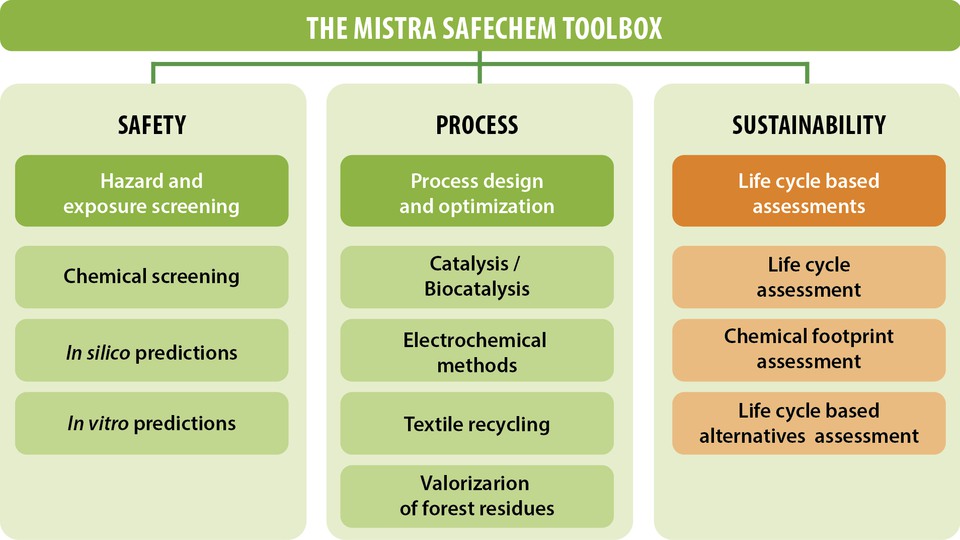
The sustainability part of the toolbox is divided into three main parts: Life cycle assessment, Chemical footprint assessment and Life cycle based alternatives assessment. Click the plus signs below to unfold the descriptions and learn more about the tools included in each part.
In Mistra SafeChem, the chemical footprint is defined as “an aggregated indicator of chemical pollution that enables the assessment of the potential human toxicity and ecotoxicity impacts of the entire life cycle of a product or service”. The footprint is assessed for a function that could be generated by a product or service. This is analogous to the terms ecological footprint, carbon footprint or water footprint (see e.g. Towards a common conceptual framework for chemical footprint bridging Risk Assessment and Life Cycle Assessment: Short review and way forward External link, opens in new window.). Relevant protection areas when conducting a Chemical footprint assessment (CFA) are human health and ecosystem quality.
A CFA is the combination of a life cycle inventory (LCI) and a life cycle impact assessment (LCIA). The tools described below contribute to the completeness of both LCI and LCIA for CFA. The focus is on the further development of USEtox and ProScale, two LCIA tools for calculating human toxicity and ecotoxicity indicators in LCA.
USEtox
USEtox is used for life cycle impact assessment (LCIA). It is a scientific consensus model, endorsed by UNEP's Life Cycle Initiative, for characterizing human and ecotoxicological impacts of chemical emissions and chemicals in products. USEtox calculates characterization factors including fate, exposure, and effect factors. USEtox 3 includes near-field and far-field environments. USEtox is being further developed in several projects, including Mistra SafeChem.
Contact: Peter Fantke
Articles:
Exposure and toxicity characterization of chemical emissions and chemicals in products: global recommendations and implementation in USEtox External link, opens in new window.
Ecotoxicity characterization of chemicals: Global recommendations and implementation in USEtox External link, opens in new window.
Background information: www.usetox.org External link, opens in new window.
Status: Ready for use
ProScale
ProScale is a method that provides a hazard and exposure based scoring system for comparing chemical risks associated with products from a life-cycle perspective. ProScale uses readily available data from REACH (specifically a combination of ECETOC tiered risk assessment for exposure and CLP/GHS hazard classification for hazard) to assess the toxicological potential of product systems. The ProScale for human health toxicity potential (ProScale-H) focuses on toxicity via direct exposure and is operational. The refinement of ProScale-H and the development of ProScaleE for ecotoxicological potential are ongoing in several projects, including Mistra SafeChem.
Contact: Tomas Rydberg, Peter Saling
Article: Global Human Toxicity Potential assessed with the ProScale method for use in Normalisation in LCA External link, opens in new window.
Reports:
A ProScale case study on indoor wall paint Pdf, 1 MB, opens in new window.
ProScaleE – user needs and perspectives. Interview study for the development of the ProScale methodology External link, opens in new window.
Background information:
ProScale – A life cycle oriented method to assess toxicological potentials of product systems (2017) External link, opens in new window.
www.proscale.org External link, opens in new window.
Status: Ready for use
In silico models for substance property predictions (USEtox)
Machine learning model to predict non-cancer human health effect factors for life cycle impact assessment (LCIA). Output compatible with USEtox. Additional models for yet other endpoints may be added.
Contact: Peter Fantke, Kerstin von Borries
Article: Two-Stage Machine Learning-Based Approach to Predict Points of Departure for Human Noncancer and Developmental/Reproductive Effects External link, opens in new window.
Status: Ready for use
In silico models for substance property predictions (ProScale)
The in silico prediction tools in hazard and exposure screening toolbox Opens in new window. are well suited for initial hazard assessment in ProScale when a substance is not on the market and therefore not classified according to regulatory requirements. Guidance documents on this use of the tools are under development.
Contact: Tomas Rydberg
Article: Manuscript in progress
Status: Work in progress
The aim of informed substitution is to reduce or eliminate chemical hazards and associated risks by replacing a chemical of concern with an alternative solution that has a better safety and sustainability profile than the chemical being phased out. A functional approach allows the identification of alternatives beyond the one-to-one substitution of one chemical for another. A life cycle approach allows the identification of trade-offs.
A life cycle assessment (LCAA) framework is presented here as a tool for informed substitution. In this tool description, the LCAA framework is based on USEtox 3. Complementary use of other LCIA tools is envisaged and will be described on the page Case studies Opens in new window..
Life cycle based alternatives assessment for chemical substitution
Life cycle based alternatives assessment (LCAA) framework to consistently integrate quantitative exposure and life cycle impact performance into the substitution process. Tier-based assessment process based on USEtox 3.
Contact: Peter Fantke
Article: Life cycle based alternatives assessment (LCAA) for chemical substitution External link, opens in new window.
Status: Ready for use
-
2024-06-28 | newsImpressive achievements of Mistra SafeChem in phase 1
-
2024-06-19 | newsNew report: Crystal Engineering for Water Treatment
-
2024-05-17 | newsSee the full agenda for our final webinar
-
2024-05-15 | newsThe Mistra SafeChem in silico toolbox presented at the SETAC conference
-
2024-04-03 | newsFour more years – Mistra SafeChem gets go-ahead for second phase