

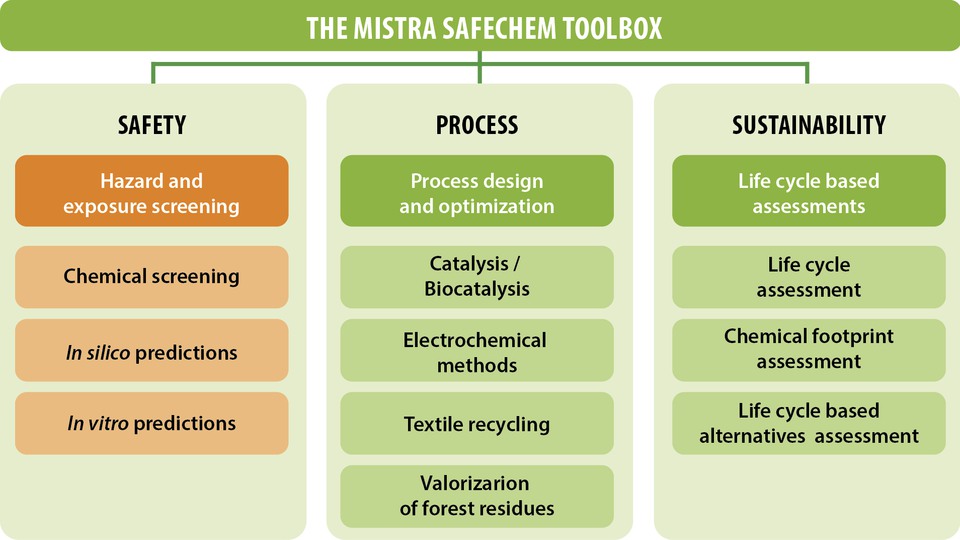
Toolbox: Hazard and exposure screening
Defined approaches are characterised by the combination of in littero, in silico and in vitro hazard prediction methods in a decision framework. The starting point is usually a situation where there is insufficient literature data to say whether a chemical is hazardous in a particular way.
If data is not available, in silico tools are applied as appropriate. The results can be used as the basis for a decision based on certainty, either to advise on hazard or to proceed a biological test to confirm or not the hazardous property. Defined approaches are not necessarily regulatory compliant, based on acceptance guidelines, but allow screening decisions to be made. The current focus is on defined approaches for mutagenicity, endocrine disruption and skin sensitization, where the decision points are clearly defined.
Non-target screening, focus textile
A fully automated solvent-free high-throughput analytical method for the screening of health hazards in textiles. The method is based on automated online thermal desorpion with GC/MS (gas chromatography/mass spectrometry). Under discussion as a standardised method for textile screening.
Contact: Ulrika Nilsson
Articles:
Solvent-free automated thermal desorption-gas chromatography/mass spectrometry for direct screening of hazardous compounds in consumer textiles External link, opens in new window.
Cellulose Nanocrystals from Postconsumer Cotton and Blended Fabrics: A Study on Their Properties, Chemical Composition, and Process Efficiency External link, opens in new window.
Disperse azo dyes, arylamines and halogenated dinitrobenzene compounds in synthetic garments on the Swedish market External link, opens in new window.
Suspect and non-target screening of chemicals in clothing textiles by reversed-phase liquid chromatography/hybrid quadrupole-Orbitrap mass spectrometry External link, opens in new window.
Manuscript in progress: The fate of hazardous textile pollutants in an upcycling process for post-consumer garments. Contact: Ulrika Nilsson
Status: Ready for use
Non-target screening, surface water monitoring
Procedure for screening and characterising chemicals in water. Water samples are filtered and injected directly into the LC-Orbitrap-HRMS by online solid phase extraction and data acquisition in positive and negative mode with data-independent MS2 analysis. Data pre-processing in MS-DIAL, spectral matching to MassBank and GNPS, and options for molecular networking and in silico structure prediction.
Contact: Jon Martin
Article: Nontarget Analysis of Polluted Surface Waters in Bangladesh Using Open Science Workflows External link, opens in new window.
Status: Ready for use
Non-target sampling of surfaces and air
Pre-cleaned polydimethylsiloxane (PDMS) sheets and foam are exposed to commercial materials (e.g. surface materials in cars) or air (e.g. car cabin) and analysed by target or non-target analysis.
Contact: Jon Martin
Background material: Silicone Foam for Passive Sampling and Nontarget Analysis of Air External link, opens in new window.
Status: Ready for use
AI-based prediction tools
A testbed of AI-based prediction tools has been developed using cutting-edge AI-algorithms. This includes:
- Endocrine disruption hazard screening suite (consisting of models for twelve endocrine endpoints)
- CMR hazard screening suite (consisting of models for carcinogenicity, mutagenicity and reproductive toxicity endpoints)
- ECOTOX hazard screening suite (consisting of models for BCF, bioaccumulation, and persistence endpoints)
Contact: Swapnil Chavan
Article: hERG-toxicity prediction using traditional machine learning and advanced deep learning techniques External link, opens in new window.
Status: Ready for use
Machine learning based tools (2)
In silico toolbox with models for 23 endocrine receptors, three ecotoxicological endpoints (biodegradation, bioaccumulation, persistence) and several other toxicological endpoints (carcinogenicity, mutagenicity and reproductive toxicity).
Contact: Ulf Norinder
Articles:
In Silico Identification of Potential Thyroid Hormone System Disruptors among Chemicals in Human Serum and Chemicals with a High Exposure Index External link, opens in new window.
Predicting Endocrine Disruption Using Conformal Prediction – A Prioritization Strategy to Identify Hazardous Chemicals with Confidence External link, opens in new window.
Status: Ready for use
Biotransformation prediction
Application of a selection of (bio)transformation pathway prediction tools to predict plausible abiotic and biotic transformation pathways and products of chemicals and chemical alternatives. Evaluation of in silico predictions using experimental (bio)degradation tests according to OECD guidelines in combination with suspect screening analytical techniques. A methodology involving the combined use of in silico tools, experimental testing and suspect screening methods for the prediction and identification of transformation products.
Contact: Gunnar Thorsén, Ioannis Liagkouridis
Article: Assessing the Environmental Transformation of Alternative Chemicals Using in Silico Tools, (Bio)Degradation Testing and Suspect Screening – a Case Study of Emerging Alternative Plasticizers External link, opens in new window.
Status: Ready for use
Eye irritation and skin sensitization predictions based on solubility parameters
Prediction of eye irritation and skin sensitization using Hansen solubility parameters and predicted pKa values.
Contact: Martin Andersson, Mikael Kjellin
Article: In Silico Prediction of Eye Irritation Using Hansen Solubility Parameters and Predicted pKa Values External link, opens in new window.
Status: Ready for use
High-content screening of cell phenotypes
Cell painting assay that enables detailed phenotypic cell profiling by using high content screening (HCS), multiplexing of six stains, and automated image analysis. This novel tool captures large amounts of unbiased information to quantify the cellular state following a chemical perturbation.
Contact: Oskar Karlsson
Article: High-content analysis shows synergistic effects of low perfluorooctanoic acid (PFOS) and perfluorooctane sulfonic acid (PFOA) mixture concentrations on human breast epithelial cell carcinogenesis External link, opens in new window.
Status: Ready for use
Fit-for purpose high-content screening protocols
Staining protocols combining several antibodies or stains can be developed to address specific toxicological questions, provide mechanistic understanding, and improve the predictive potential.
Contact: Oskar Karlsson
Articles:
High-content analysis shows synergistic effects of low perfluorooctanoic acid (PFOS) and perfluorooctane sulfonic acid (PFOA) mixture concentrations on human breast epithelial cell carcinogenesis External link, opens in new window.
Tumorigenic activity of alternative per- and polyfluoroalkyl substances (PFAS): Mechanistic in vitro studies External link, opens in new window.
Differential susceptibility of rat primary neurons and neural stem cells to PFOS and PFOA toxicity External link, opens in new window.
Status: Ready for use
Protocols for analysing epigenetic effects
Combination of experimental model systems, molecular assays and omics tools to study gene-environment interactions and the epigenetic basis of disease.
Contact: Oskar Karlsson
Articles:
High-content analysis shows synergistic effects of low perfluorooctanoic acid (PFOS) and perfluorooctane sulfonic acid (PFOA) mixture concentrations on human breast epithelial cell carcinogenesis External link, opens in new window.
Tumorigenic activity of alternative per- and polyfluoroalkyl substances (PFAS): Mechanistic in vitro studies External link, opens in new window.
Status: Ready for use
-
2024-06-28 | newsImpressive achievements of Mistra SafeChem in phase 1
-
2024-06-19 | newsNew report: Crystal Engineering for Water Treatment
-
2024-05-17 | newsSee the full agenda for our final webinar
-
2024-05-15 | newsThe Mistra SafeChem in silico toolbox presented at the SETAC conference
-
2024-04-03 | newsFour more years – Mistra SafeChem gets go-ahead for second phase